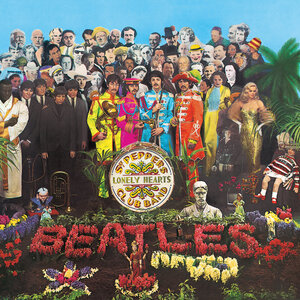
Showing posts with label Beatles. Show all posts

Wednesday, 5 August 2015

Garment 13: Estate Donation 3: Puzzle (3/5)


Polyester double-knit: all the optimism of the hippy movement, in easy-care wash-and-wear

Background

Twiggy - swinging girl

Here's a puzzle: what to do with a large garbage-bag full of too-small-to-bother scraps of Early Space-Age textiles. None big enough to be a pocket: they should have been chucked when all the pieces of the A-Line Twiggy dresses - and later, the plaid, Mary Tyler Moore pant suits - had been cut. But they weren't, and here they were, 50 years later, in a black plastic bag between my knees, as I sorted donations at Our Social Fabric. An estate donation - I didn't know we had received it, so there hadn't been a chance to thank the donor, or ask my usual questions: who was she? What did she sew, and for whom?

I had only the clues in the one bag, and I wasn't learning much: she sewed. A lot. She liked colour, texture, plaid. She was fashionable, and - despite the unrestrictive fashions of the time - no doubt usually uncomfortable: nearly every scrap was 100%, non-breathing, abrasive-textured, double-knit polyester. She must have been perpetually chafed and sweaty. But she looked good. If not a little pilly.

Mary Tyler Moore - working girl


I wondered: was she on the bus? Did she work? Did she love the Beatles? And why did she save those scraps? What was it about the pieces - too useless, even, for the OSF Free Bin - that caused her to keep them all, and for so long? Too small for garments, not absorbent enough for rags. Not for patches... polyester doesn't wear out. What was she expecting to do with them? I took them home to see if they could tell me their purpose. If not, I would have to throw them out.

It seemed wrong to chuck such hopeful fabric, when it had waited so long: hopeful colours, hopeful patterns, hope for equality, for love, peace and change. Hope for the future. With all that hope, could the pieces really be so hopeless? But there is nothing at all useful about a massive bagful of dinky, ugly, non-absorbent, abrasive, polyester off-cuts... except maybe to piece together like some wash-and-wear, perma-press, crazy quilt. Or something more useful... like a housedress... Or an apron... Or a pop-over! Well! What else could I do?
The back - what a load of scraps!

No scrap was altered in the making of this utilitarian, pull-over pinafore. What you see is exactly what I found in the bag: strange, jagged cuts; long, narrow strips; tapering slivers of psychedelic colours - the negative shapes that remained from making all those fabulous outfits. Three days' sifting produced the right interlocking pieces to accommodate the curved edge of the neckline, armholes and hem. Good thing I like puzzles.

Grain, the Music and Being on the Bus

But wait: there's more! The hang of a garment depends (almost) entirely upon the grain of the fabric, which, in the case of double-knit polyester, should run perpendicular to the floor. This made for tricky scraps placement. Not only did they need to conform to the outline of the pattern, but each piece had to be on grain to prevent wobble and twist. Luckily, there were lots to choose from, and I had Jake Bugg to keep me company!

Jake Bugg
Jake Bugg: the young English singer who caused me to realize we may not be going to Hell in a hand basket, after all. What a relief.

Instead, we are riding the same wave of hope the Beatles rode with everybody else who was on the bus - the Beatles so far in front they seemed to be pulling the wave. They channelled the zeitgeist of the time, providing a sound track to social change that was rooted in hope. That wave crashed, but now is cresting again, and with the aid of information technology it's many times more powerful. Artists like Jake Bugg and movements like Our Social Fabric are riding along with it. These are very hopeful times; we might just yet clean up the mess we're in.

Who is Jake Bugg? He is not his influences: the Beatles, the Everly's, Don McLean, Johnny Cash, Donovan, Neil Young or Hendrix. He is not Dylan, though I see the comparison. But he is special like them. He intrigues me for his honesty, modesty, sharp commentary on his own experiences, and his indifference to public opinion. Like the Beatles, the important thing is the music.
Read the Rolling Stone review of Jake Bugg's first album
Listen to a song: Broken (start at 53sec)

Pattern and Sewing

Solvy, diagonal basting, on freehand embroidery sample
The design was done the usual way, by altering a flat-drafted pattern on a mannequin until it looked just right. However, the sewing is unconventional. There are none of the usual seams. The scraps fit together to form the 3-D shape, sewn edge to edge, without seam allowances. A whole lot of Solvy and diagonal basting* was employed in the construction, as well as some old, abandoned rick rack, which provides the bust shaping and delineates the neckline and armholes. For sewing nerd details, click here.
*You might be wondering: what is diagonal basting? It's a revelation, that's what: the best stitch ever for holding pieces exactly where you want them, prior to machining. It is also quick, and uniquely satisfying.

Pocket and Button

"Buttonhole test" pocket
The hip pocket is made of a buttonhole test, found with the scraps. (What did she save that for?!) The cheap-ola, plastic button - original dingy thread intact - came from a garment discarded decades ago. A new shank was created with special thread from a flight attendant - a friend of a friend - who flew in the days when stewardesses were required to be trained nurses and wore high heels and pillbox hats. On layovers she bought sewing goodies: silk buttonhole thread - lustrous and delightful for hand sewing. Some of the tiny spools are now mine.

Sewing the button on this top caused me to ponder two ways to sew on buttons. One results in a tiny, recurrent thrill, and utilises a toothpick. The other is nifty and quick. Which one did I use?
Spot the two fabrics not from the scrap bag. 
Hint: Cygnet and Authorship

Note to Jake

Thanks for reviving my optimism and for helping me finish this puzzle. More music please! I'll keep checking to see what you come up with next.


Size S-M. Available
For a hand-copied pattern, please contact me.
Good photography by Jeff Minuk www.lostinkits.com

Puzzle 1: Buttons Two Ways - Tutorial
Puzzle 2: Blatant Advertising
Puzzle 4: Puzzle Top Tutorial
Puzzle 5: Rick Rack Tutorial

Monday, 20 July 2015

House 1 : Beaumont


Wikipedia informs me the Beaumont was produced by GM for the Canadian market between 1962 and 1969. Survivors are now collector cars, as most "succumbed" to the harsh Canadian winter.

This beautifully corroded car badge was already affixed to the inside of the cobweb-filled garage when we moved in. It was put there, I am fairly certain, by Mr. A. Renwick, house painter and second owner of our home, two before us. A fellow who grew up in the house across the lane  confirmed my suspicions: Mr. Renwick* owned a Beaumont in the '60s. A brown one.
*The fellow pronounced it "Rennick"


I'll show you mine if you show me yours
The lick of drab, peach-coloured paint under that badge matches the under-sides of the shelves in the linen closet - which comprised about 20% of the total closet space when we moved in. How did people stay organized with so little storage?! Surely they didn't have any less stuff than I have... 

It's not a particularly efficient closet, either: it's shallow and the shelves are poorly spaced. What did the Renwicks keep in there? Not their broom; a broom won't fit. Linen, folded just the right way so the door can close? A dismantled vacuum cleaner, a large box of rags, assorted headlamps, swim goggles, light bulbs, bandaids, syringes, needles*, alcohol swabs, and a spare sharps container?
*Did you know syringes and needles are two different things? Neither did I!

I get a kick out of the weird paraphernalia of my existence - items I'd never heard of, let alone imagined I'd ever own or need: Lycra body socks, Therabands and Chewellery* for intense proprioceptive input. Visual schedules for front-loading and transitions; a cheat sheet on my fridge in case of my own dysregulation; and a checklist on the bulletin board - "30 Good Things About ADHD" - to remind me.

*later replaced by parkour classes
A visual schedule; it's key
The side of my fridge. The grey thing is a juicer key, for all the apples in July.
My son insisted I add the paraphrasing, lower left.

But the weirdest to me is the sharps containers. There is one in the kitchen, one in the bathroom, sometimes one on my dresser, a spare or two in the hall closet. Though the novelty of giving my daughter her nightly shot has long worn off, I still marvel at the presence of the yellow boxes of medical waste that decorate my rooms, and at the fact that my superpower turns out to be the ability to give a one-handed injection, in the dark, to a sleeping child - without waking her up. (That, and I'm pretty good at parallel parking.)
Not the elegant, 2-in-1 solution I had envisioned

Whenever I find myself startled at the sight of the severe-looking plastic box with the red biohazard symbol, it crosses my mind that there must be some better way to incorporate it into my decor. But how? It was a eureka moment when I hit upon the idea to disguise it with a toilet roll doll, thereby also solving the perplexing puzzle of how to give one of those seriously useless - but bizarrely appealing - dolls some legitimate function in life. Let's face it, hiding toilet paper doesn't count as useful.

Sadly, the doll won't stand up straight in the wide hole of the sharps box, and it's a pain to lift her dress to get the needle in. Ah well... another idea will surely come. Meanwhile, the box in my kitchen works great for holding garlic.


Just-picked garlic, curing
I would love to invite them for tea - the Renwicks and anybody else who's ever lived here. I'd sort out exactly who sat in my living room, watching Elvis from the waist up, or swooning over the Beatles on Ed Sullivan. I want to know about the clothes in the insufficient closets: were there flour sack dresses, followed by utility clothing, then crinolines, then A-line mini dresses and boots made for walking? We can commiserate about our socks, snagged on that nail* in the hallway that keeps poking back up.
*That nail, by the way, is responsible for the demise of many a Phentex slipper, explaining why you will rarely find me in a proper, matching pair - my signature look

They will know to duck going down the basement stairs, and not to park under the tulip trees in summer*. I will thank them for leaving the various, painted nails in the living room - perfectly positioned for birthday streamers, Christmas stockings, and front door wreaths.
*aphid poop

I'll ask what weird things they accumulated, what surprising skills they acquired. I'll learn how Mr. Renwick's Beaumont came to be separated from its badge and how that swipe of closet paint found its way to the wall of the garage. I'll find out where they kept their stuff.


Before the garage collapses completely,
I will extract the Beaumont badge.
I'm thinking chain saw...
July 2015

Thursday, 22 January 2015

Garment 6: Time Traveller, 1965


This cheerful sweater started off as a donation to OSF of a long-ago abandoned sewing project - a barely-begun, pre-Lycra stretchy cardigan. My first reaction upon pulling it out of the green garbage/donation bag was to put it directly in the Free Box: youthfully yellow, yet oddly frumpy; droopy rib-knit fabric; darts in a knit??! Rust stains from a pin stuck in it over the course of decades. A little musty, in a bag that had gone the way old plastic bags can go. There didn't seem any hope.

But something about its hopelessness encouraged me to live with it a bit first, to see if it would suggest a way to make it useful and wanted. Within a day or two it started a conversation with a bright, rich pink, deliciously soft, damaged, cashmere cardigan I had plucked from a friend's bag of cast-offs destined for the Sally Ann. They've been together ever since.

The donation came from an elderly lady who can no longer sew, and whose son is systematically taking control of her fabric hoarding. When she is lucid she tells him which fabric can go; when she's not she accuses him of stealing. He shows up at OSF sales bearing bags or boxes of his mother's stash, and a sad, but satisfied smile. It's the usual personal donation: two or three yards each of many types of fabric, just enough for one outfit, plus a few bags of scraps. The last box usually contains the notions, patterns, maybe tools: pinking sheers, or a chalk-filled hem marker, half-empty bobbins with five different colours of thread on each, a tin heavy with buttons, dome fasteners and useful bits removed from garments long gone. I often develop a fondness toward the original owner of the personal donations. We would recognize each other if only we had met.

I've been enjoying sorting this donation more than most. As ever, each fabric has something to say about the person who saved it, but this time it's a person living and sewing in the '60s, the decade that never ceases to inspire me, and into the 70s, when polyester double-knit really got crazy. Finding the usefulness and beauty in butt-ugly polyester double-knit is a special interest of mine.

Only the scraps, Ma'am
I haven't claimed any of the lengths of fabric for my own. They're all too nice, and too useful. But I did score big-time on a large variety of small, irregularly-shaped scraps, which any but the most stalwart Waste-Not would declare to be totally useless. Rapture! Several types of hideous, slack-suit-weight polyester double-knit, candy or psychedelic-coloured. One or two snippets of bark cloth. Red, white and blue Mary Tyler Moore-esque extra-stretchy double-knit: droopy-when-wet, underarm-abrading textured polyester swimsuit, anyone? Barely a natural fibre to be seen. I left the projects she didn't start, and took the remains of the projects she finished, and some she gave up on. A tasty challenge.

They just wanted to be together
The main pieces of the cardigan were already cut, neatly marked with inconspicuous blue dots at all the important places, and sewn with a straight stitch at the side seams and shoulder - there was even perfectly matched seam tape to stop the shoulder from stretching. This lady could sew! But that's as far as she went; the project was abandoned, everything folded neatly and placed in a clear plastic bag, with one or two pins for good measure. My guess is it was abandoned for lack of a serger. After all, a person who bothers to tape shoulders won't be satisfied trying to sew stretch fabric on a straight stitch machine. But why save it all these 40-some years? Was she optimistically awaiting the day she might own a serger? Did she stubbornly refuse to admit defeat? Did she forget she even had it -- every single time she came across it? Intriguing.

A clue to its age: it has bust darts, suggesting it was cut from a non-stretch pattern, likely bought prior to 1967, when Stretch & Sew patterns first became available. The colour speaks to the era of psychedelia, but the style is modest, more Please Please Me than Sgt. Pepper; I wonder how old she was at the time. I wonder where it was kept all that time, and I wonder if she groaned every time she came across it, like I would. Or maybe it didn't bother her at all...

The side seams and shoulders were re-cut to be less matronly-y, and the edges finished with the ribbing, cuffs and button placket from the pink sweater. The pink is attached to the yellow with simple back stitches picked by hand. It looks like a running stitch on the front, but is actually a little stretchy. I used a spool of pink ribbony floss that has been sitting in my embroidery box since taking a VSB night class in couture beading with Blossom Jenab, about 15 years ago. I've been wanting to use that floss ever since, and working with it has been smooothly satisfying.

I'm happy with the result, and I like to think the lady who so carefully began it would be pleased to know her project is finally finished.


Useful sewing tip

Most people do as little hand sewing as possible, thinking it is not fun, or it's hard. I can't help with the fun part (though I do enjoy it, myself, in moderation), but there is a simple fact that, if understood, makes it so much easier.

All sewing is all about the grain. Thread has grain. When hand-sewing, the direction the thread is sewn should be the same as it came off the spool. Some folks recommend immediately knotting the thread at the cut end, even before threading the needle, just to be sure to get the direction right. Ignoring the grain results in thread that will knot easily, making hand sewing seem much harder than it needs to be. And not fun.

If you want to use a double strand, do not simply put one strand on the needle and knot the two ends of it together. The difference in the grains will make the threads fight with each other, and it will be a tangly bugger to sew with. Instead, cut two strands, lay them together in the same direction, thread them both through the same needle (tricky, but can be done), knot them together at the end, and sew away.

Speaking of hand sewing, I have read many places that the only proper way to do it is to wax the thread beforehand. I asked Blossom about this, since I've never seen her wax her thread, and she replied that thread these days is strong enough without waxing. Followed by that little "tsk" she sometimes does. So there it is. Couture sewing might be considered by some to be synonymous with doing everything the hard way, but not harder than necessary. I suspect those articles are written by folk who don't wax their thread, either, even if they do sew with the grain.

Size S, but not very small. For sale by appointment. Enquiries at enoughstuffblog@gmail.com

Wednesday, 21 January 2015

Garment 3: Exploration #1: Lucy in the Sky with Diamonds

Answer quite slowly

My record player!
I discovered Elvis playing hot potato at Teresa Armstrong's 8th birthday party in 1973, her mother dropping the needle randomly onto that thrilling record to signal us to GO! and doing her best to lift it up again without scratching the vinyl, to STOP! An exciting game for an 8 year-old, but not as exciting as the feeling inside my body when I heard that incredible voice.

I returned home to enthusiastically tell my mom about the new singer I'd just discovered. Turns out, she had been just as excited to discover him, years before. A few months ago I watched my 7 year-old daughter dance around the living room, clutching an old vinyl copy of Blue Hawaii, and squealing, "He's so sexy!" The apples didn't fall far from this fuzzy tree. She, too, was all shook up.

That Christmas I received three Elvis albums. I played them continuously on my plastic Sears Wish Book stereo, writing out the lyrics to the songs as fast as I could. Later, my first CD purchase was a box set of Elvis' complete '50s catalogue. I didn't even own a CD player yet.

The Beatles I discovered over the course of decades. The first of their songs to transfix me was "Lucy in the Sky with Diamonds". For a period of months in 1980, I repeatedly pencilled the opening line on the surface of my desk in Mr. Humphrey's Social Studies classroom. I was in grade 10. "Picture yourself in a boat on a river..." And she's gone.

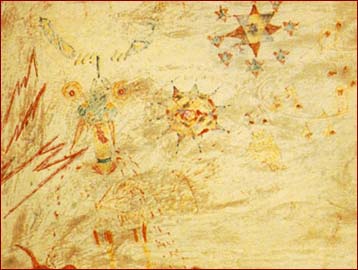
Julian Lennon's drawing, Lucy in the Sky with Diamonds
John Lennon was inspired to write the song when his son returned home from preschool with a drawing he had made of his friend, Lucy. She was in the sky. With diamonds. I, myself, have a painting by my son entitled Vase of Crud and Stuff. There could be a song in there, I suppose, or certainly a garment made of abandoned materials.

Inspiration can come from anywhere. When it does, it is simply a matter of shutting up and letting it come, flowing from the universe through the mind and right down to the earth. I think this is what I responded to as I slouched in my seat, doodling Lucy. That pure, channelled song has been stuck in my head now for 35 years. So has "The Lonely Goatherd", though that one I'm not so sure about.

Back
This top is my homage to "Lucy in the Sky with Diamonds". The first of two identical metallic blue/brown tunics made of hand-me-down fabric, it features extended shoulders, French darts, French seams, bias trimmed hems and a draped collar with a mind of its own. My very first felting project, I spent 8 blissful hours stuffing the roving fibres through from the front to the wrong side to anchor the loose, discarded threads and serger dregs that make up the lettering. When it was over I ran machine stitching along it once or twice, to make sure it wasn't going anywhere. Guess what I was listening to...

I hope the blue will become crumbly and faded-looking, and the brown will show through the cracks even more. Though the fabric is pre-shrunken, washing gently will preserve the felting.

Answer quite slowly. Or, shut up brain, I'm trying to listen!


Size M. For sale by appointment. Enquiries at enoughstuffblog@gmail.com

Tuesday, 20 January 2015

Garment 4: Exploration #2: Sie Liebt Dich

Sie Leibt Dich, yeah, yeah, yeah
The "Sie Liebt Dich" top is the second of two metallic blue+brown, over-sized, sleeveless tunics born out of a beautiful relationship with the first garment I ever draped for myself.

The background

Blossom's blossoms. Sigh.
The pink linen top with safety-pin daisies that preceded "Sie Liebt Dich" was inspired by one of Blossom's exquisite embroidery samples, and draped as homework for a collar class. Comfortable and easy to wear, I lived in it all last summer. The only thing is, a draped collar is not meant to go into battle, as Blossom would say. The kiss of death is creasing the gently folded neck edge: no washing, no drying, and certainly no ironing. I ignored this fact completely when choosing the linen fabric and utilitarian design for such a delicate feature as a couture-technique collar. Figured I would deal with it later.

Before: perky
But as I said, I wore it a lot, and eventually it needed to be washed! I went to all kinds of lengths to preserve the collar: I washed it by hand, holding the precious collar out of the water. When it got wet anyway I hung it dry, taking pains to separate the collar layers, thereby keeping the fold uncreased - kind of. I steamed it, wearing an oven-mitt-like protective ironing .....mitt. Eventually, I gave in and chucked the thing in with all the other wash. 

After: flacid - in a good way
It was a sad moment, knowing my beautiful collar was most sincerely dead. After a brief period of mourning I took a look to see if there was anything to be salvaged. Well... the whole thing, actually! It looks terrific! It has gone from crisp, precise, hovering, elegant, full of hope and promise to soft, droopy, relaxed, comfortable, enveloping, wrinkled, creased, experienced and full of character. I loved it before, but I love it after, too! It's like trying to decide which version of my daughter I love best: the smiley, snugly baby who smells like butterscotch; the wobbly toddler with the black eye, splashing in the toilet when I'm not looking; the almost-8-year-old who rubs my back when I vomit "because we're connected, you know". I love them all, and I love the transformation.

The garment, itself

I love it so much I made two copies so someone else and someone else might enjoy it, too. Cotton or linen or a blend, the fabric was handed down to me by a friend. It's a bit heavy, and I expect the colours will crack eventually. Hope so, anyway; it will be good consolation for killing that poor draped collar.


Sie Liebt Dich


"Sie Liebt Dich" is one of only two songs The Beatles ever recorded in another language, the other being "Komm, Gib Mir Deine Hand". The German branch of their record label suggested it, convinced their records wouldn't sell in Europe, otherwise. Though they didn't feel it was necessary to their growing popularity, the Beatles all reluctantly agreed, being a little sweet on Germany, having practically grown up there, after all, to misquote John Lennon. The general consensus is that the pronunciation is done well, but they refused to ever translate their songs again. Just as well; they had other, more important, things to do!

Interesting tidbit half-remembered from a memoir by John Lennon's personal assistant during his time in New York: John Lennon did speak some German, but it was phrases like, "How much for the hour?" or some-such. And there exists a wonderful snip of George Harrison being interviewed in German and singing as much as he can remember of a German folk song. https://www.youtube.com/watch?v=Uj5tmhdcUAA

"She Loves You" is important for these reasons:

  • it is considered a landmark in the evolution of song-writing by John and Paul. A seemingly insignificant detail - the story is told in the third person - is the zero point of their radical departure from the typical way of writing songs of the time (e.g. "Hello Little Girl"). One small step for the Beatles, one large step for mankind. You can trace the trajectory directly from "She Loves You" to the perfection that is the 2nd side of Abbey Road, through all the other moments of sublime brilliance, intuition, inspiration and world-changing innovation in between. They channelled the muse, man.
  • it captures the essence of the screaming, fainting and unprecedented bizarre fan behaviour that was Beatlemania, before it had a name, and while it was still a novelty. On the day of the recording session, a swollen gaggle of fans broke through the meagre security in the building, resulting in running and chasing and chaos all through the studio. From this point on, the Beatles increasingly became prisoners of their popularity. But on the day of the recording they had no idea of what craziness was to come. The adrenaline boost caused by the hysteria is evident in the recording: it's pure excitement, itself. 
  • The choice of the word, "yeah", rather than "yes", ignited social upheaval, and shows how plugged in to the zeitgeist of the time the Beatles really were. The phrase will be forever associated with everything to do with the '60s.

On the decoration

The writing on the garment is made of the threads and dregs that come off when a fabric is serged before pre-shrinking (i.e. what normally goes into the garbage) - in this case a c. 1970 green and white polka-dot polyester double-knit, and a pink nylon tricot, of uncertain age, but likely intended for a slip or negligee. These have been stitched over with freehand machine embroidery - a very pleasant way to spend an hour or two.

On the spelling of the decoration

I struggled with the spelling of "yeah" in German. Ja? That didn't sit right. The top waited, unfinished, for weeks, while I dwelled and asked around. Happened to meet the principal of a Vancouver German school, who seems to have a particular interest in how words become appropriated from other languages. I put the question to her, and after thinking out loud for a bit, she emphatically proclaimed the correct spelling to be y-e-a- h. Just as the Beatles refused strong advice to change "yeah" into "yes", they also refused to translate it into "ja" - of course it should be "yeah"! I admire the Beatles for staying true to their instincts way back then. I aspire to be even half as fearless.


Size M. For sale by appointment
Enquiries at enoughstuffblog@gmail.com

Monday, 19 January 2015

Garment 2: Logan Lake, 1973


Skirt Front, Upholstery Samples
On the hill over-looking our house, c. 1970. That's me in pink
Fuzzy Felts- hours of fun
This skirt makes me think of crock pots, kitchen wallpaper, Fuzzy Felts, a little copper mining town in the interior of British Columbia...

My sister had Fuzzy Felts, and I babysat for a family that did not have a huge Elvis Presley record collection, but did have a crock pot and two boxes of Fuzzy Felts, which kept me occupied until the mom and dad got back from whatever it was they did in a town that, at the time, had no secondary school, restaurants, or doctor.

The only store sold day-old bread, canned goods, paper products, the kind of soap you need when carving a fake soapstone sculpture in grade 5, cinnamon or mint flavoured toothpicks, and two sizes of chocolate bars - 5 cents or 10 cents. Also, candles and other birthday party paraphernalia, including the Beatles cake-top tableau that adorned the angel-food money-cake with marshmallow icing made by my mother for my eighth sleepover birthday party. Pam Kaus and I wore matching shorty pyjamas purchased at the Fields in Merritt - the nearest town with dentists. The very birthday I received Donny Osmond Superstar, the double album I really, really wanted. But only one of the records. And not the good one.

Donny Osmond Superstar. Sigh
It was 1973; I was in grade 3 - best year of my life - the year I broke my arm, sliding with my sister on the hill behind our house while my parents were away at a curling bonspiel.

When we arrived back at the Keurver's, pulling the toboggan in shock and pain behind me, they took me first to Kelly Courtney's dad - the Lornex first aid attendant. My arm splinted, he sent us on to Kamloops, to the hospital, an hour away. Nothing so exciting had ever happened to me, nor would for many years.

As did every girl in my class, I had a crush on Donny Osmond. Pam and I - dressed in matching leotards, snap-crotch bodysuits, and plush-lined, zippered, Naugahyde winter boots - made up creative dances to "Pretty Blue Eyes" and "Puppy Love" in her parents' wood-panelled rumpus-room. I drew him pictures to hang on the wall of his bedroom - the side view of a girl in prayer, done in yellow marker... I had heard he was religious. I wondered about his bed - rumoured to be suspended from the ceiling! - and his drawer-full of purple socks. 
Birthday cake decoration. Ringo's drum is broken. Where's Paul?
I hadn't heard of the Beatles, yet - had no inkling there could be anything bigger than Elvis. I wanted this particular cake decoration because there was no Elvis one to be had.

Rediscovered when I was forty-something in a yellowed, plastic produce bag at my parents', along with every half-burnt candle from every childhood birthday cake my mother ever made for us, and all the fancy ballerinas that usually held our candles, I shrieked when I pulled it out of the box.

Paul is - ironically -missing.
Beautiful cyclops fire-dancing ballerinas - most elegant birthday candle holders
Souvenir from Lornex company picnic
Mother's Day gift, from Sears, now hangs in my kitchen
This skirt reminds me of our house: peering through the kitchen window, orange and brown diamond-patterned curtains, the boom of the blasting in the open pit mine, a 20-minute drive away; wet-look, vinyl swivel chairs - also orange -  the smiling daisy wall plaque that now hangs in my kitchen. 

My sister and I chose it at the Kamloops Sears during a routine trip to buy the necessities not available in our village: freshly baked bread, Kentucky Fried chicken, birthday presents.

Dad would let us loose with two dollars in an incense-scented shop that sold novelty printed toilet paper, Herbal Essences shampoo and witty plastic statuary. A carefully selected, slightly squishy, white, plastic figurine of a baby in diapers - "Life is one damp thing after the other" - sat atop our TV, between school pictures: me and my sister in wood-printed, cardboard frames. When she hated me, mine would face the wall.

My sister, napping, green shag rug
There was a wood-burning fireplace and wall-to-wall shag carpet in shades of medium green, which required regular raking - a 1973 zen garden embedded with crumbs, cat hair, dead skin, Grape Nuts cereal, the odd Barbie shoe and Orange Tang crystals.

Dry Tang from the package, orange fingers, the Flintstones - cuddled up with Shayne Morgan in the big chair after school. Freckles and a big smile.

This skirt makes me think of all that.

The first of my own designs I ever showed Blossom, she proclaimed the Logan Lake skirt to be "perfect" and I have no cause to doubt her. It's cut from her own instructions for transforming the perfect basic block into the perfect A-line skirt pattern - one of the first variations she teaches in her flat pattern drafting classes. So no wonder.

Skirt Back, defective reflective piping, bias waistband, hem and zipper facing

When wallpaper was wallpaper, hung c. 1975
I believe the fabric to be linen, c.1970, sister to the wallpaper in our Kamloops kitchen, where we lived next. It was 1977; the eve of New Wave. I cried silently the first time I saw it.

The linen, from a fabric sample card, came from the estate donation of Addie, a prolific creative force who lovingly rescued - judging from the attached tickets - every stray piece of fabric she ever encountered. Samples, seconds, bolt ends, yardage: six minivans-full of fabrics and notions plus a mannequin and extensive supplies for all her other hobbies: fabric dying, painting on fabric or glass, glass painting, knitting - by hand or machine - pottery. She was a gardener, too. In the months it took for us to sort, we felt we got to know her.
Hook and eye; raw edges of fold-over waistband will not fray

Since there was so little of the fabric, the bias waistband, hem and fly facing are pieced together from small scraps left from cutting the back panel of mis-matched green linen. There was just enough fabric.
The metal zipper, hook and eye came from my stash, removed from a worn-out, discarded garment by an ancestor of mine a generation or more ago - possibly my mom's mom. The reflective piping is defective, and came from a local sportswear manufacturer who must remain nameless. It will crack and flake off a little with each cleaning.
Like my memories of the mining town that inspired it, I anticipate this skirt will soften and improve with age.

All that's left
Purchase enquiries at enoughstuffblog@gmail.com


Friday, 2 January 2015

Garment 1: Agenda

Front - one of these arm slits is not like the other
This satisfying poncho is made of three new-but-old mohair scarves that once belonged to a friend's mother-in-law. New because they were unworn. Old because they were acquired over the course of a long lifetime, along with other mohair scarves, sweaters, coats, blankets...

Seems this lady had a big soft spot for mohair, but a big disinterest in wearing it. Or was there more to it? What attracted her to mohair? The loftiness? The luxuriousness? Did it remind her of a place or time? Or a person? Was there an empty space inside her that only mohair could fill?

Why didn't she wear it? Itchy? Allergic? Hot? It reminded her of some place, or time, or person? Was there an empty space in her that no amount of mohair could fill? This is what I wondered while my mind percolated on the weightless puffs - so cloud-like they refused to be properly folded.

Back
I stared at them for many hours over many days before they gave up their secret. Even so, making the only cut was a complete leap of faith. My friend was counting on me. Or was that me?

The construction consisted mainly of pulling and separating the yarns from the edges of the scarves to use for stitching. I wasn't sure at first if I should pull the threads from the long or the short edges, but both proved equally - surprisingly! - stubbornly enmeshed. I don't know much about the process of weaving mohair, but from trying to un-make it I've deduced that it must require some sort of felting step. It looks airy and nearly fragile, but it's no pushover. It took an hour to produce each decent length of unbroken, not-too-frayed sewing thread, regardless if it was warp or weft. After that, stitching it by hand with a darning needle was easy-peasy lemon squeezy.

Back fringe detail
Clues
Small ball of yarn fluff
My only agenda was to create a true zero-waste garment, using all of the 3 mohair scarves, and nothing but the 3 mohair scarves; the rest was up to the mohair scarves, themselves. I came pretty close to my goal. This small ball of fluff and yarn is all that was left. It's earmarked for a future project involving The Beatles starring in their first full-length, hilarious, action-packed film!  "A Hard Day's Night". And some felting. Still percolating.

Note: A tiny brown mark just under the front right collar was original to the scarf when I received it.

Hmm. Maybe she did wear mohair.


Size S-M. For sale by appointment. Enquiries at enoughstuffblog@gmail.com
Photography by Jeff Minuk www.lostinkits.com