Showing posts with label re-purposeful. Show all posts

Saturday, 24 January 2015

Garment 8: Authorship


This angel top was inspired by a 1967 Stretch & Sew pattern I've made up for myself in 3 different cheap-ola abandoned knits . There are plans for more to come.

I loved the shape and fit so much I started to wondering how much an existing design would need to be changed before it could be considered one's own. More a musing than anything, I still haven't bothered to find out for sure. This lead me to drape the angel top, based on the way the neck edge of the raglan sleeves and bodice pieces fold back to form the square neck facing. It got my brain doing contortions trying to work it out, which says more about my brain than the complexity of the pattern. Sewed it up from more abandoned, cheap-ola, t-shirt knit and even more cheap-ola rib-knit fabric, both of which came from Addie's stash, and there you have it.


The pinwheel is made from stitch samples found in a number of manila envelopes - along with an instruction disk each - that had accompanied brand-new, but now obsolete, computerised embroidery machines. Not old, and no doubt still use-able, but obsolete - like my cellphone. The volunteers at the OSF sorting bee had a good laugh when I asked if anyone might want the disks. We dumped them, and two of us took some of the stitch samples home to percolate. I especially like the pencilled-in stitch type, width and tension notes. Wonder whose job that was, and how much she was paid to do it: endlessly stitching samples to accompany shiny new machines, after the kids went to bed, no doubt. What a job.


The yellow fabric is a snippet from a very large, cheerful, stained, polyester double-knit book dust-cover. It was donated by a woman who told me it was made by her elderly grandmother, a tailor, and had been used to protect a "holy book" in a Vancouver temple. Not sure the exact type of temple... I didn't ask enough questions when the donation came in.

The Delta Airlines pin, "Good Going", was found in a cookie tin of junk discovered on a rummage through the dregs of the Prophouse restaurant when it closed for business.

Creepy '70s ad
I know the design is mine now, because it makes me think of Charlie's Angels, Farrah Fawcett's feathered hair, Love's Baby Soft perfume. To be worn with your best bra, unless you plan on keeping your hands in your lap all evening.


Size S-M. For sale by appointment. 
Enquiries at enoughstuffblog@gmail.com

Friday, 23 January 2015

Garment 7: Cygnet


This is the fabric that started my fascination with ugly-duckling, polyester double-knit. It came as a donation to OSF, probably from Addie's stash. I had what could only be described as a "strong, negative visceral reaction" to it as I rolled the jagged remnant, tied on the pink elastic and dumped it into the "ready" bin. I shuddered. I tsked. I snorted. Ew, grey and beige...what! What the heck is this print supposed to be, exactly? Apples? Playing cards? Exploding cupcake batter? All three? What was the designer thinking? What was the point of this fabric? Surely there was no piece of material less likely to inspire. It was so uninspiring, in fact, that I couldn't stop thinking about it.

I tucked it into my volunteer appreciation bag with a challenge to myself to make its existence meaningful. Or at least try. Until that point I had never worked with polyester double-knit, having a marked prejudice against it that people often teased me about. Static-y, non-breathing, so unnatural-feeling. It reminded me of the imitation jeans I wore in the early 70s. The sweatiness of it all! It would be a real challenge just to enter in to the challenge.

I vaguely intended to make a shortie, Beatles-esque, collarless jacket, but that afternoon I went for tea with two fellow volunteers at OSF, and they challenged me to leave my comfort zone: I was instructed to make a baseball jacket. A baseball jacket? That would never have occurred to me! I couldn't sleep for the excitement. As soon as I found two hours to rub together I began a riff on a jacket I wore c. 1980: it was metallic brownish-gold, hip-length, raglan-sleeved, and stiffened uncomfortably in cold weather. When it was no longer remotely stylish I consigned it to my (then embryonic) fabric stash, where it stayed until it became completely adhered to itself with sticky decay. 

There was less than a metre of the fabric, so I pulled out some water-proof "technical fabric" for the rest, and tied it together with some donated, reject, reflective piping. It is lined with a piece of buttery soft Bemberg I had on hand, and closes with an old, metal zipper, also from my stash.


What a pleasure to sew! The polyester didn't fight me at all! And it comes out of the dryer needing no further assistance to look its unwrinkled best. No wonder polyester became so popular in the '70s!

To my delight, the response to the jacket has been very positive; strangers have feelings about it they feel compelled to share with me. I've got plans for another, to be sewn from a particularly offensive piece of fabric that also completely baffles me (see left). The jostled imperialist, holding tight to his top hat shouts over the sound of the traffic, "Peace, rickshaw driver, but could you possibly pick up the pace?"


Thursday, 22 January 2015

Garment 6: Time Traveller, 1965


This cheerful sweater started off as a donation to OSF of a long-ago abandoned sewing project - a barely-begun, pre-Lycra stretchy cardigan. My first reaction upon pulling it out of the green garbage/donation bag was to put it directly in the Free Box: youthfully yellow, yet oddly frumpy; droopy rib-knit fabric; darts in a knit??! Rust stains from a pin stuck in it over the course of decades. A little musty, in a bag that had gone the way old plastic bags can go. There didn't seem any hope.

But something about its hopelessness encouraged me to live with it a bit first, to see if it would suggest a way to make it useful and wanted. Within a day or two it started a conversation with a bright, rich pink, deliciously soft, damaged, cashmere cardigan I had plucked from a friend's bag of cast-offs destined for the Sally Ann. They've been together ever since.

The donation came from an elderly lady who can no longer sew, and whose son is systematically taking control of her fabric hoarding. When she is lucid she tells him which fabric can go; when she's not she accuses him of stealing. He shows up at OSF sales bearing bags or boxes of his mother's stash, and a sad, but satisfied smile. It's the usual personal donation: two or three yards each of many types of fabric, just enough for one outfit, plus a few bags of scraps. The last box usually contains the notions, patterns, maybe tools: pinking sheers, or a chalk-filled hem marker, half-empty bobbins with five different colours of thread on each, a tin heavy with buttons, dome fasteners and useful bits removed from garments long gone. I often develop a fondness toward the original owner of the personal donations. We would recognize each other if only we had met.

I've been enjoying sorting this donation more than most. As ever, each fabric has something to say about the person who saved it, but this time it's a person living and sewing in the '60s, the decade that never ceases to inspire me, and into the 70s, when polyester double-knit really got crazy. Finding the usefulness and beauty in butt-ugly polyester double-knit is a special interest of mine.

Only the scraps, Ma'am
I haven't claimed any of the lengths of fabric for my own. They're all too nice, and too useful. But I did score big-time on a large variety of small, irregularly-shaped scraps, which any but the most stalwart Waste-Not would declare to be totally useless. Rapture! Several types of hideous, slack-suit-weight polyester double-knit, candy or psychedelic-coloured. One or two snippets of bark cloth. Red, white and blue Mary Tyler Moore-esque extra-stretchy double-knit: droopy-when-wet, underarm-abrading textured polyester swimsuit, anyone? Barely a natural fibre to be seen. I left the projects she didn't start, and took the remains of the projects she finished, and some she gave up on. A tasty challenge.

They just wanted to be together
The main pieces of the cardigan were already cut, neatly marked with inconspicuous blue dots at all the important places, and sewn with a straight stitch at the side seams and shoulder - there was even perfectly matched seam tape to stop the shoulder from stretching. This lady could sew! But that's as far as she went; the project was abandoned, everything folded neatly and placed in a clear plastic bag, with one or two pins for good measure. My guess is it was abandoned for lack of a serger. After all, a person who bothers to tape shoulders won't be satisfied trying to sew stretch fabric on a straight stitch machine. But why save it all these 40-some years? Was she optimistically awaiting the day she might own a serger? Did she stubbornly refuse to admit defeat? Did she forget she even had it -- every single time she came across it? Intriguing.

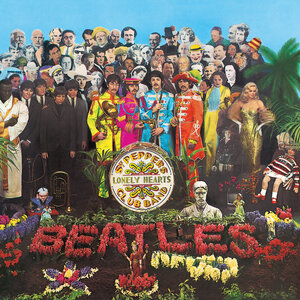
A clue to its age: it has bust darts, suggesting it was cut from a non-stretch pattern, likely bought prior to 1967, when Stretch & Sew patterns first became available. The colour speaks to the era of psychedelia, but the style is modest, more Please Please Me than Sgt. Pepper; I wonder how old she was at the time. I wonder where it was kept all that time, and I wonder if she groaned every time she came across it, like I would. Or maybe it didn't bother her at all...

The side seams and shoulders were re-cut to be less matronly-y, and the edges finished with the ribbing, cuffs and button placket from the pink sweater. The pink is attached to the yellow with simple back stitches picked by hand. It looks like a running stitch on the front, but is actually a little stretchy. I used a spool of pink ribbony floss that has been sitting in my embroidery box since taking a VSB night class in couture beading with Blossom Jenab, about 15 years ago. I've been wanting to use that floss ever since, and working with it has been smooothly satisfying.

I'm happy with the result, and I like to think the lady who so carefully began it would be pleased to know her project is finally finished.


Useful sewing tip

Most people do as little hand sewing as possible, thinking it is not fun, or it's hard. I can't help with the fun part (though I do enjoy it, myself, in moderation), but there is a simple fact that, if understood, makes it so much easier.

All sewing is all about the grain. Thread has grain. When hand-sewing, the direction the thread is sewn should be the same as it came off the spool. Some folks recommend immediately knotting the thread at the cut end, even before threading the needle, just to be sure to get the direction right. Ignoring the grain results in thread that will knot easily, making hand sewing seem much harder than it needs to be. And not fun.

If you want to use a double strand, do not simply put one strand on the needle and knot the two ends of it together. The difference in the grains will make the threads fight with each other, and it will be a tangly bugger to sew with. Instead, cut two strands, lay them together in the same direction, thread them both through the same needle (tricky, but can be done), knot them together at the end, and sew away.

Speaking of hand sewing, I have read many places that the only proper way to do it is to wax the thread beforehand. I asked Blossom about this, since I've never seen her wax her thread, and she replied that thread these days is strong enough without waxing. Followed by that little "tsk" she sometimes does. So there it is. Couture sewing might be considered by some to be synonymous with doing everything the hard way, but not harder than necessary. I suspect those articles are written by folk who don't wax their thread, either, even if they do sew with the grain.

Size S, but not very small. For sale by appointment. Enquiries at enoughstuffblog@gmail.com

Garment 5: Connect


This undemanding, raspberry-coloured vest started life as furniture. The little square of soft, unevenly faded, slightly floppy, discarded bit of used upholstery came to OSF in a personal donation. I imagine the donor hesitating: Keep. Throw. Donate! Surely someone can find some use for this!

It spent days in the Free Box, until I couldn't ignore it any more. I love the way the fading suggests its original use: I guess an ottoman, or the seat of a chair. It was very dirty, and crusty with glue, so I serged the edges, chucked it in the washer and dryer and crossed my fingers. It came out beautifully: soft-soft, and as lovely on the one side as the other. I knew I had found just the right fabric for the plastic tortoise shell/metal elephant buttons I had loved as a child, sorting through my mother's button tin. I drafted this little vest to use up as much of the fabric as possible. There was barely enough left after cutting to test the sewing machine tension.


Sadly, my mother's buttons had become too brittle, and one of them broke after it was sewn on. They were replaced with lonely, mismatched, fabric-covered buttons I've also been saving for the right garment. I hope these buttons originally belonged to lady-like, little jacket-and-skirt sets with 3/4-length sleeves. Worn with gloves. Maybe an imitation leopard-skin pillbox hat...


Size S. For sale by appointment. Enquiries at enoughstuffblog@gmail.com

Wednesday, 21 January 2015

Garment 3: Exploration #1: Lucy in the Sky with Diamonds

Answer quite slowly

My record player!
I discovered Elvis playing hot potato at Teresa Armstrong's 8th birthday party in 1973, her mother dropping the needle randomly onto that thrilling record to signal us to GO! and doing her best to lift it up again without scratching the vinyl, to STOP! An exciting game for an 8 year-old, but not as exciting as the feeling inside my body when I heard that incredible voice.

I returned home to enthusiastically tell my mom about the new singer I'd just discovered. Turns out, she had been just as excited to discover him, years before. A few months ago I watched my 7 year-old daughter dance around the living room, clutching an old vinyl copy of Blue Hawaii, and squealing, "He's so sexy!" The apples didn't fall far from this fuzzy tree. She, too, was all shook up.

That Christmas I received three Elvis albums. I played them continuously on my plastic Sears Wish Book stereo, writing out the lyrics to the songs as fast as I could. Later, my first CD purchase was a box set of Elvis' complete '50s catalogue. I didn't even own a CD player yet.

The Beatles I discovered over the course of decades. The first of their songs to transfix me was "Lucy in the Sky with Diamonds". For a period of months in 1980, I repeatedly pencilled the opening line on the surface of my desk in Mr. Humphrey's Social Studies classroom. I was in grade 10. "Picture yourself in a boat on a river..." And she's gone.

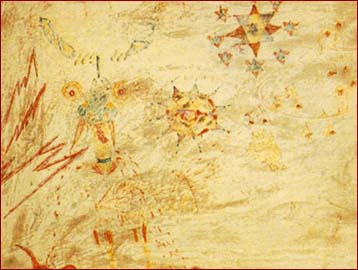
Julian Lennon's drawing, Lucy in the Sky with Diamonds
John Lennon was inspired to write the song when his son returned home from preschool with a drawing he had made of his friend, Lucy. She was in the sky. With diamonds. I, myself, have a painting by my son entitled Vase of Crud and Stuff. There could be a song in there, I suppose, or certainly a garment made of abandoned materials.

Inspiration can come from anywhere. When it does, it is simply a matter of shutting up and letting it come, flowing from the universe through the mind and right down to the earth. I think this is what I responded to as I slouched in my seat, doodling Lucy. That pure, channelled song has been stuck in my head now for 35 years. So has "The Lonely Goatherd", though that one I'm not so sure about.

Back
This top is my homage to "Lucy in the Sky with Diamonds". The first of two identical metallic blue/brown tunics made of hand-me-down fabric, it features extended shoulders, French darts, French seams, bias trimmed hems and a draped collar with a mind of its own. My very first felting project, I spent 8 blissful hours stuffing the roving fibres through from the front to the wrong side to anchor the loose, discarded threads and serger dregs that make up the lettering. When it was over I ran machine stitching along it once or twice, to make sure it wasn't going anywhere. Guess what I was listening to...

I hope the blue will become crumbly and faded-looking, and the brown will show through the cracks even more. Though the fabric is pre-shrunken, washing gently will preserve the felting.

Answer quite slowly. Or, shut up brain, I'm trying to listen!


Size M. For sale by appointment. Enquiries at enoughstuffblog@gmail.com

Tuesday, 20 January 2015

Garment 4: Exploration #2: Sie Liebt Dich

Sie Leibt Dich, yeah, yeah, yeah
The "Sie Liebt Dich" top is the second of two metallic blue+brown, over-sized, sleeveless tunics born out of a beautiful relationship with the first garment I ever draped for myself.

The background

Blossom's blossoms. Sigh.
The pink linen top with safety-pin daisies that preceded "Sie Liebt Dich" was inspired by one of Blossom's exquisite embroidery samples, and draped as homework for a collar class. Comfortable and easy to wear, I lived in it all last summer. The only thing is, a draped collar is not meant to go into battle, as Blossom would say. The kiss of death is creasing the gently folded neck edge: no washing, no drying, and certainly no ironing. I ignored this fact completely when choosing the linen fabric and utilitarian design for such a delicate feature as a couture-technique collar. Figured I would deal with it later.

Before: perky
But as I said, I wore it a lot, and eventually it needed to be washed! I went to all kinds of lengths to preserve the collar: I washed it by hand, holding the precious collar out of the water. When it got wet anyway I hung it dry, taking pains to separate the collar layers, thereby keeping the fold uncreased - kind of. I steamed it, wearing an oven-mitt-like protective ironing .....mitt. Eventually, I gave in and chucked the thing in with all the other wash. 

After: flacid - in a good way
It was a sad moment, knowing my beautiful collar was most sincerely dead. After a brief period of mourning I took a look to see if there was anything to be salvaged. Well... the whole thing, actually! It looks terrific! It has gone from crisp, precise, hovering, elegant, full of hope and promise to soft, droopy, relaxed, comfortable, enveloping, wrinkled, creased, experienced and full of character. I loved it before, but I love it after, too! It's like trying to decide which version of my daughter I love best: the smiley, snugly baby who smells like butterscotch; the wobbly toddler with the black eye, splashing in the toilet when I'm not looking; the almost-8-year-old who rubs my back when I vomit "because we're connected, you know". I love them all, and I love the transformation.

The garment, itself

I love it so much I made two copies so someone else and someone else might enjoy it, too. Cotton or linen or a blend, the fabric was handed down to me by a friend. It's a bit heavy, and I expect the colours will crack eventually. Hope so, anyway; it will be good consolation for killing that poor draped collar.


Sie Liebt Dich


"Sie Liebt Dich" is one of only two songs The Beatles ever recorded in another language, the other being "Komm, Gib Mir Deine Hand". The German branch of their record label suggested it, convinced their records wouldn't sell in Europe, otherwise. Though they didn't feel it was necessary to their growing popularity, the Beatles all reluctantly agreed, being a little sweet on Germany, having practically grown up there, after all, to misquote John Lennon. The general consensus is that the pronunciation is done well, but they refused to ever translate their songs again. Just as well; they had other, more important, things to do!

Interesting tidbit half-remembered from a memoir by John Lennon's personal assistant during his time in New York: John Lennon did speak some German, but it was phrases like, "How much for the hour?" or some-such. And there exists a wonderful snip of George Harrison being interviewed in German and singing as much as he can remember of a German folk song. https://www.youtube.com/watch?v=Uj5tmhdcUAA

"She Loves You" is important for these reasons:

  • it is considered a landmark in the evolution of song-writing by John and Paul. A seemingly insignificant detail - the story is told in the third person - is the zero point of their radical departure from the typical way of writing songs of the time (e.g. "Hello Little Girl"). One small step for the Beatles, one large step for mankind. You can trace the trajectory directly from "She Loves You" to the perfection that is the 2nd side of Abbey Road, through all the other moments of sublime brilliance, intuition, inspiration and world-changing innovation in between. They channelled the muse, man.
  • it captures the essence of the screaming, fainting and unprecedented bizarre fan behaviour that was Beatlemania, before it had a name, and while it was still a novelty. On the day of the recording session, a swollen gaggle of fans broke through the meagre security in the building, resulting in running and chasing and chaos all through the studio. From this point on, the Beatles increasingly became prisoners of their popularity. But on the day of the recording they had no idea of what craziness was to come. The adrenaline boost caused by the hysteria is evident in the recording: it's pure excitement, itself. 
  • The choice of the word, "yeah", rather than "yes", ignited social upheaval, and shows how plugged in to the zeitgeist of the time the Beatles really were. The phrase will be forever associated with everything to do with the '60s.

On the decoration

The writing on the garment is made of the threads and dregs that come off when a fabric is serged before pre-shrinking (i.e. what normally goes into the garbage) - in this case a c. 1970 green and white polka-dot polyester double-knit, and a pink nylon tricot, of uncertain age, but likely intended for a slip or negligee. These have been stitched over with freehand machine embroidery - a very pleasant way to spend an hour or two.

On the spelling of the decoration

I struggled with the spelling of "yeah" in German. Ja? That didn't sit right. The top waited, unfinished, for weeks, while I dwelled and asked around. Happened to meet the principal of a Vancouver German school, who seems to have a particular interest in how words become appropriated from other languages. I put the question to her, and after thinking out loud for a bit, she emphatically proclaimed the correct spelling to be y-e-a- h. Just as the Beatles refused strong advice to change "yeah" into "yes", they also refused to translate it into "ja" - of course it should be "yeah"! I admire the Beatles for staying true to their instincts way back then. I aspire to be even half as fearless.


Size M. For sale by appointment
Enquiries at enoughstuffblog@gmail.com

Friday, 2 January 2015

Garment 1: Agenda

Front - one of these arm slits is not like the other
This satisfying poncho is made of three new-but-old mohair scarves that once belonged to a friend's mother-in-law. New because they were unworn. Old because they were acquired over the course of a long lifetime, along with other mohair scarves, sweaters, coats, blankets...

Seems this lady had a big soft spot for mohair, but a big disinterest in wearing it. Or was there more to it? What attracted her to mohair? The loftiness? The luxuriousness? Did it remind her of a place or time? Or a person? Was there an empty space inside her that only mohair could fill?

Why didn't she wear it? Itchy? Allergic? Hot? It reminded her of some place, or time, or person? Was there an empty space in her that no amount of mohair could fill? This is what I wondered while my mind percolated on the weightless puffs - so cloud-like they refused to be properly folded.

Back
I stared at them for many hours over many days before they gave up their secret. Even so, making the only cut was a complete leap of faith. My friend was counting on me. Or was that me?

The construction consisted mainly of pulling and separating the yarns from the edges of the scarves to use for stitching. I wasn't sure at first if I should pull the threads from the long or the short edges, but both proved equally - surprisingly! - stubbornly enmeshed. I don't know much about the process of weaving mohair, but from trying to un-make it I've deduced that it must require some sort of felting step. It looks airy and nearly fragile, but it's no pushover. It took an hour to produce each decent length of unbroken, not-too-frayed sewing thread, regardless if it was warp or weft. After that, stitching it by hand with a darning needle was easy-peasy lemon squeezy.

Back fringe detail
Clues
Small ball of yarn fluff
My only agenda was to create a true zero-waste garment, using all of the 3 mohair scarves, and nothing but the 3 mohair scarves; the rest was up to the mohair scarves, themselves. I came pretty close to my goal. This small ball of fluff and yarn is all that was left. It's earmarked for a future project involving The Beatles starring in their first full-length, hilarious, action-packed film!  "A Hard Day's Night". And some felting. Still percolating.

Note: A tiny brown mark just under the front right collar was original to the scarf when I received it.

Hmm. Maybe she did wear mohair.


Size S-M. For sale by appointment. Enquiries at enoughstuffblog@gmail.com
Photography by Jeff Minuk www.lostinkits.com