This cheerful sweater started off as a donation to OSF of a long-ago abandoned sewing project - a barely-begun, pre-Lycra stretchy cardigan. My first reaction upon pulling it out of the green garbage/donation bag was to put it directly in the Free Box: youthfully yellow, yet oddly frumpy; droopy rib-knit fabric; darts in a knit??! Rust stains from a pin stuck in it over the course of decades. A little musty, in a bag that had gone the way old plastic bags can go. There didn't seem any hope.
But something about its hopelessness encouraged me to live with it a bit first, to see if it would suggest a way to make it useful and wanted. Within a day or two it started a conversation with a bright, rich pink, deliciously soft, damaged, cashmere cardigan I had plucked from a friend's bag of cast-offs destined for the Sally Ann. They've been together ever since.
The donation came from an elderly lady who can no longer sew, and whose son is systematically taking control of her fabric hoarding. When she is lucid she tells him which fabric can go; when she's not she accuses him of stealing. He shows up at OSF sales bearing bags or boxes of his mother's stash, and a sad, but satisfied smile. It's the usual personal donation: two or three yards each of many types of fabric, just enough for one outfit, plus a few bags of scraps. The last box usually contains the notions, patterns, maybe tools: pinking sheers, or a chalk-filled hem marker, half-empty bobbins with five different colours of thread on each, a tin heavy with buttons, dome fasteners and useful bits removed from garments long gone. I often develop a fondness toward the original owner of the personal donations. We would recognize each other if only we had met.
I've been enjoying sorting this donation more than most. As ever, each fabric has something to say about the person who saved it, but this time it's a person living and sewing in the '60s, the decade that never ceases to inspire me, and into the 70s, when polyester double-knit really got crazy. Finding the usefulness and beauty in butt-ugly polyester double-knit is a special interest of mine.
 |
| Only the scraps, Ma'am |
I haven't claimed any of the lengths of fabric for my own. They're all too nice, and too useful. But I did score big-time on a large variety of
small, irregularly-shaped scraps, which any but the most stalwart Waste-Not would declare to be totally useless. Rapture! Several types of hideous, slack-suit-weight polyester double-knit, candy or psychedelic-coloured. One or two snippets of bark cloth. Red, white and blue Mary Tyler Moore-esque extra-stretchy double-knit: droopy-when-wet, underarm-abrading textured polyester swimsuit, anyone? Barely a natural fibre to be seen. I left the projects she didn't start, and took the remains of the projects she finished, and some she gave up on. A tasty challenge.
 |
| They just wanted to be together |
The main pieces of the cardigan were already cut, neatly marked with inconspicuous blue dots at all the important places, and sewn with a straight stitch at the side seams and shoulder - there was even perfectly matched seam tape to stop the shoulder from stretching. This lady could sew! But that's as far as she went; the project was abandoned, everything folded neatly and placed in a clear plastic bag, with one or two pins for good measure. My guess is it was abandoned for lack of a serger. After all, a person who bothers to tape shoulders won't be satisfied trying to sew stretch fabric on a straight stitch machine. But why save it all these 40-some years? Was she optimistically awaiting the day she might own a serger? Did she stubbornly refuse to admit defeat? Did she forget she even had it -- every
single time she came across it? Intriguing.
A clue to its age: it has bust darts, suggesting it was cut from a non-stretch pattern, likely bought prior to 1967, when Stretch & Sew patterns first became available. The colour speaks to the era of psychedelia, but the style is modest, more Please Please Me than Sgt. Pepper; I wonder how old she was at the time. I wonder where it was kept all that time, and I wonder if she groaned every time she came across it, like I would. Or maybe it didn't bother her at all...
The side seams and shoulders were re-cut to be less matronly-y, and the edges finished with the ribbing, cuffs and button placket from the pink sweater. The pink is attached to the yellow with simple back stitches picked by hand. It looks like a running stitch on the front, but is actually a little stretchy. I used a spool of pink ribbony floss that has been sitting in my embroidery box since taking a VSB night class in couture beading with Blossom Jenab, about 15 years ago. I've been wanting to use that floss ever since, and working with it has been smooothly satisfying.
I'm happy with the result, and I like to think the lady who so carefully began it would be pleased to know her project is finally finished.
Useful sewing tip
Most people do as little hand sewing as possible, thinking it is not fun, or it's hard. I can't help with the fun part (though I do enjoy it, myself, in moderation), but there is a simple fact that, if understood, makes it
so much easier.
All sewing is all about the grain. Thread has grain. When hand-sewing, the direction the thread is sewn should be the same as it came off the spool. Some folks recommend immediately knotting the thread at the cut end, even before threading the needle, just to be sure to get the direction right. Ignoring the grain results in thread that will knot easily, making hand sewing seem much harder than it needs to be. And not fun.
If you want to use a double strand, do not simply put one strand on the needle and knot the two ends of it together. The difference in the grains will make the threads fight with each other, and it will be a tangly bugger to sew with. Instead, cut two strands, lay them together in the same direction, thread them both through the same needle (tricky, but can be done), knot them together at the end, and sew away.
Speaking of hand sewing, I have read many places that the only proper way to do it is to wax the thread beforehand. I asked Blossom about this, since I've never seen her wax her thread, and she replied that thread these days is strong enough without waxing. Followed by that little "tsk" she sometimes does. So there it is. Couture sewing might be considered by some to be synonymous with doing everything the hard way, but not harder than necessary. I suspect those articles are written by folk who don't wax
their thread, either, even if they do sew with the grain.
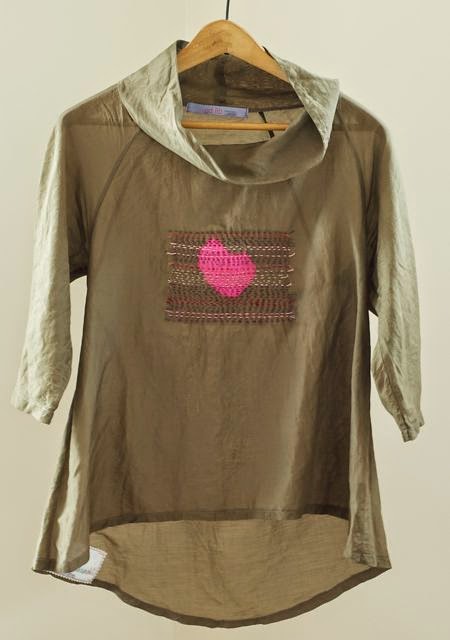
 It doesn't belong to me, either, though it's adorable and I think I could totally rock it. It is owned by another friend and fellow OSF board member, Kat Siddle, who bought it from Zoe one night when we were picking up a donation of fabric from her home.