Homework for Master Recycling class: a personal waste audit. Held on to all household waste for 2 weeks to see what I could see. This is the bag that came from the sewing room trash can. Clockwise, from top (before sorting):
Marathon of Hope sticker. September - when a young girl's thoughts turn to Terry Fox. My daughter ran for Terry.
Two lunch bag love notes can be made from one grocery store receipt.
Yellow name tag from a hand-me-down backpack from the kids two doors away.
Candy wrapper - one of two unexplained bits of trash found during my audit. Curiosity plus independence, or the beginnings of hyperphaegia? Too early to tell, but the next stage of Prader-Willi syndrome is long overdue.
Thread snips and embroidered, used, alcohol swabs (you read that right) - the Humatrope Collar is finally finished! These are the rejects from making the labels.
Broken twin needle - altered some clothes for a friend.
Granola wrappers - haven't been eating properly.
Fish food package - my daughter finally owns a pet. Violet the beta is very well-fed.
Light bulb from sewing room - I spend a lot of time here, late into the night. Not quite sure how to dispose of it...
Polyester double-knit: all the optimism of the hippy movement, in easy-care wash-and-wear
Background
Twiggy - swinging girl
Here's a puzzle: what to do with a large garbage-bag full of too-small-to-bother scraps of Early Space-Age textiles. None big enough to be a pocket: they should have been chucked when all the pieces of the A-Line Twiggy dresses - and later, the plaid, Mary Tyler Moore pant suits - had been cut. But they weren't, and here they were, 50 years later, in a black plastic bag between my knees, as I sorted donations at Our Social Fabric. An estate donation - I didn't know we had received it, so there hadn't been a chance to thank the donor, or ask my usual questions: who was she? What did she sew, and for whom?
I had only the clues in the one bag, and I wasn't learning much: she sewed. A lot. She liked colour, texture, plaid. She was fashionable, and - despite the unrestrictive fashions of the time - no doubt usually uncomfortable: nearly every scrap was 100%, non-breathing, abrasive-textured, double-knit polyester. She must have been perpetually chafed and sweaty. But she looked good. If not a little pilly.
Mary Tyler Moore - working girl
I wondered: was she on the bus? Did she work? Did she love the Beatles? And why did she save those scraps? What was it about the pieces - too useless, even, for the OSF Free Bin - that caused her to keep them all, and for so long? Too small for garments, not absorbent enough for rags. Not for patches... polyester doesn't wear out. What was she expecting to do with them? I took them home to see if they could tell me their purpose. If not, I would have to throw them out.
It seemed wrong to chuck such hopeful fabric, when it had waited so long: hopeful colours, hopeful patterns, hope for equality, for love, peace and change. Hope for the future. With all that hope, could the pieces really be so hopeless? But there is nothing at all useful about a massive bagful of dinky, ugly, non-absorbent, abrasive, polyester off-cuts... except maybe to piece together like some wash-and-wear, perma-press, crazy quilt. Or something more useful... like a housedress... Or an apron... Or a pop-over! Well! What else could I do?
The back - what a load of scraps!
No scrap was altered in the making of this utilitarian, pull-over pinafore. What you see is exactly what I found in the bag: strange, jagged cuts; long, narrow strips; tapering slivers of psychedelic colours - the negative shapes that remained from making all those fabulous outfits. Three days' sifting produced the right interlocking pieces to accommodate the curved edge of the neckline, armholes and hem. Good thing I like puzzles.
Grain, the Music and Being on the Bus
But wait: there's more! The hang of a garment depends (almost) entirely upon the grain of the fabric, which, in the case of double-knit polyester, should run perpendicular to the floor. This made for tricky scraps placement. Not only did they need to conform to the outline of the pattern, but each piece had to be on grain to prevent wobble and twist. Luckily, there were lots to choose from, and I had Jake Bugg to keep me company!
Jake Bugg
Jake Bugg: the young English singer who caused me to realize we may not be going to Hell in a hand basket, after all. What a relief.
Instead, we are riding the same wave of hope the Beatles rode with everybody else who was on the bus - the Beatles so far in front they seemed to be pulling the wave. They channelled the zeitgeist of the time, providing a sound track to social change that was rooted in hope. That wave crashed, but now is cresting again, and with the aid of information technology it's many times more powerful. Artists like Jake Bugg and movements like Our Social Fabric are riding along with it. These are very hopeful times; we might just yet clean up the mess we're in.
Who is Jake Bugg? He is not his influences: the Beatles, the Everly's, Don McLean, Johnny Cash, Donovan, Neil Young or Hendrix. He is not Dylan, though I see the comparison. But he is special like them. He intrigues me for his honesty, modesty, sharp commentary on his own experiences, and his indifference to public opinion. Like the Beatles, the important thing is the music.
Read the Rolling Stone review of Jake Bugg's first album
Listen to a song: Broken (start at 53sec)
The design was done the usual way, by altering a flat-drafted pattern on a mannequin until it looked just right. However, the sewing is unconventional. There are none of the usual seams. The scraps fit together to form the 3-D shape, sewn edge to edge, without seam allowances. A whole lot of Solvy and diagonal basting* was employed in the construction, as well as some old, abandoned rick rack, which provides the bust shaping and delineates the neckline and armholes. For sewing nerd details, click here. *You might be wondering: what is diagonal basting? It's a revelation, that's what: the best stitch ever for holding pieces exactly where you want them, prior to machining. It is also quick, and uniquely satisfying.
Pocket and Button
"Buttonhole test" pocket
The hip pocket is made of a buttonhole test, found with the scraps. (What did she save that for?!) The cheap-ola, plastic button - original dingy thread intact - came from a garment discarded decades ago. A new shank was created with special thread from a flight attendant - a friend of a friend - who flew in the days when stewardesses were required to be trained nurses and wore high heels and pillbox hats. On layovers she bought sewing goodies: silk buttonhole thread - lustrous and delightful for hand sewing. Some of the tiny spools are now mine.
Sewing the button on this top caused me to ponder two ways to sew on buttons. One results in a tiny, recurrent thrill, and utilises a toothpick. The other is nifty and quick. Which one did I use?
Spot the two fabrics not from the scrap bag. Hint: Cygnet and Authorship
Note to Jake
Thanks for reviving my optimism and for helping me finish this puzzle. More music please! I'll keep checking to see what you come up with next.
My neighbour said this to me one year ago, departing my house by the back door for the very last time. Ain't that the truth.
From a home to a health hazard, just like that
I know when they bought the house they intended to stay. The first time we met, on a playdate at the park, brokered by him (with whom in the alley, a day or two before, I had had a brief and cordial discussion about composting), she told me she wanted to be the kind of neighbour you could call up to borrow a cup of sugar. I liked her instantly. Not just sugar, either, but food colouring, ice, gin, wheelbarrow...
One last look at our house from their deck. Our shingles don't match...
We became friends and neighbours, not just friendly neighbours. Our youngest occasionally played ninjas together. Our oldest were usually civil. Good enough. They included us when they entertained. I watered their garden and fed their cat when they were away. We had each other's house keys, alarm codes, and - most coveted - sitter's contact information.
Morning glory
We were careful not to overstep each other's boundaries, but the gate to the back garden was always unlocked (she kept kale plants there, mostly for me) and the welcome mat at their sliding kitchen doors was always out. They were the kind of neighbours you could visit in your pyjamas. And he mixed a mean, well-edited selection of cocktails.
Carpet underlay should be felt and not seen
I'm not always great with life's transitory nature. Good or bad, I seem to need more than the standard amount of time to process change. So, demolition underway, I find myself drawn back to my ex-neighbours' ex-house, for one last look and a souvenir snapshot. I think they might appreciate an update and a picture of the mess.
Soon the diggers roll in
They are an important part of the history of that little purple house (blue, actually, but it was their house; they can call it what they like). They are its last family. That their leaving would likely mean the end for the house, too, must have made the decision doubly hard. Though they hoped to attract a family that would love it the way they did, the house is old, small, and quirky. Development was inevitable.
Unlike me, she had no issue with buttercup
Standing in the overgrown riot of raspberry, roses, weeds and rubble, my attention begins to focus. That is not just broken wainscoting; it is the orange-red trim from their kitchen. That's not just a mess of gutted cabinets, but the lazy Susan that once held their casserole dishes. There's the cupboard with tea, crackers and cat treats. I spent many hours in that kitchen, watching her decorate her secret-family-recipe Shortbread Nut Sticks with melted chocolate and a toothpick. I know it well. I'm not looking at any old half-demolished house; this is their half-demolished house.
She gave me this euphorbia 3 years ago. I think his old bike will feel at home here.
I see him, flipper in hand, hovering near the BBQ on the back deck, Canadian flag hanging above him. I see her annual Christmas party spread: apple cider on the stove, a crockpot of meatballs on the table, platters of bacon-wrapped dates, chicken wings, cheese and home baking on the metal coffee table. I see the children in their Hallowe'en costumes, made of cardboard, imagination and love.
I glance past the piles of broken drywall, fibre-board and counter top, and notice the tangled, jungly remains of what used to be their vegetable garden. The morning glory, as she knew it would, has won. In three days the house, and the garden, will be gone. Soon enough another house - new, comfortable, efficient - will exist in its place. Wonder if the new neighbours will be the kind you can call up to borrow a cup of sugar.
Cans hanging in the lilac bush are a sort of penitence
There were three healthy, mature lilacs growing along the East garden fence when we moved into our old-timer house in 1998. The only lilac I had ever known to that point, which lived in our back yard in Kamloops, was a bush, not a tree, and the flowers, being at nose height, were easily enjoyed. In a mistaken attempt to return the flowers of my tree to where they belonged - where I could smell them - I had a friend saw all three trees down to one-foot-high stumps. I shudder when I think of it. This lilac bush is the only one to survive. For 17 years I've been trying to correct that lamentable mistake, one of my very first acts as a gardener. I don't remember what promted me to hang the first of a growing collection of no-longer-useable, abandoned watering (and other) cans from the branches. The "installation" just sort of happened. The cans distract from the awkward, ugly stump and the badly-pruned branches shooting out the top. I rather like the bush as it is now, especially with the volunteer ferns that help hide the unsightly stump, but I definitely regret giving the order that day.
A house-warming gift from Mr. Renwick
Cheapola, abused Ikea can
Doronicum, from a soon-to-be-bulldozed garden. I like the spent flower heads.
Isn't this green one a beauty? The other was found in the parking lot adjacent the Chemainus Theatre on Vancouver Island
I look forward to my lilac blooming around Mother's Day each year. The flowers are white, large, and especially heavenly-smelling at 7 PM. Most years I bring in a big bouquet, which sits elegantly on the back of the toilet, giving off a fantastic scent that fills the house, until I get tired of picking the fallen florets out of my Phentex slippers, and eventually chuck the lot in the yard waste container.
At some point in the summer I will haul out the aluminium ladder - a gift for my husband that I really bought for myself - and snap off the dried-up flower heads. Pruning is on-going, as small stems are constantly budding out in all the wrong directions, and suckers periodically come up beside the stump. Furthermore, the bush is too close to the fence, and has power lines hanging above it, so there's always strategic branch removal happening. I've tried to encourage another lilac, a gift from a friend on a very sad occasion, to grow in other parts of the garden, but no luck. The rest of the yard is just too shady.
The first item to adorn the bush, an ancient, rusty paint can, was found in the rafters of the garage when we bought the house. There had been three other owners before us, including Mr. A. Renwick, house painter, and his family. I expect the can was his. Mr Renwick's touch is all over the house, and he took good care of it. The doors and door frames, though wood, he meticulously painted a different, more classy, faux wood - a detail I've seen in some other houses of the same age in the neighbourbood. (I wonder, did he paint those houses, too?) I found the faux wood very... something, and with apologies to Mr. Renwick and the help of a can of Kilz Primer, which seems to stick to everything, including varnish, I had the trim painted over in glossy, candelabra white. I wonder what Mr. Renwick would say to that. The hours it must have taken him to painstakingly create that imitation wood grain... Later, at a yard sale in Southlands, I found a bedside table with identical, hand-painted, faux wood grain. I feel a little bit better about obliterating Mr. Renwick's careful work, having that piece of furniture to remind me what it used to look like.
The rest of the cans, milk jug and enamel-coated kettle appeared at various times, from alleys, garage sale "free" boxes, hand-me-downs, and Ikea. The Ikea watering can is the only one I paid for, bought shortly after we moved in. It wasn't long before the spout separated and the bottom dropped out - not to mention the handle getting crushed underfoot. (Aw, come on... watch where you're stepping!) Nowadays, there's nothing I want from Ikea, aside from gingersnaps, the occasional package of frozen meatballs, and a rare jar of lingonberry jam.
All the cans have holes, except for the red gas can, which is too sketchy-looking to use for gas, and was left behind in the neighbour's shed when they moved away. I think it had been there when they moved in, too. I felt like I was removing a precious artifact, but we were told the house would be demolished, and I wanted to make sure this gorgeous specimen wasn't demolished along with it.
Speaking of novice gardening mistakes, other biggies made around this time include:
removing the pear tree (it looked scabby) and;
digging out the evergreen shrubs hiding the less attractive portion of the front of the house. I used to have a thing against evergreen shrubs, though I can't remember what, exactly. They are serviceable, undemanding, and they smell good, too. I replaced these sensible workhorses with fussy, raised, matching flower beds on either side of the front steps, one of which, due to being right up against the plaster, caused the wall to buckle, and hastened the rotting of our wooden steps. It has since been replaced by three evergreen shrubs, much like the originals, found, half dead, dumped in a heap behind a house a block and a half away. I hauled the least dead of them home on my son's plastic, Fisher-Price baby wagon, a hand-me-down from a friend who has been extremely generous to me with her son's clothing and toys. I baby those shrubs with frequent, deep drinks from a barely trickling hose, and three years later, depending on the angle, they look much less dead.
Lesson learned: wait at least a year before making any changes to any newly acquired garden. It's hard to be patient, especially when you've just treated yourself to a new set of gardening gloves, a Costco-sized container of bone meal and a lovely, sharp set of garden shears, but it's worth it. Abandoned cans might hide a number of sins, but they can't bring back all the delicious pears we didn't eat these last 17 years.
It took 8 years to dawn on me that my son was as attached to me as I was to him. I don't know what took me so long: his attachment didn't look the way I expected it to, but it has always been right there in front of me. And how. When he is sick he wants me near. Depending on how much he wants the contents, he will sip from my glass, but from no other's. When he's especially attached he'll let me clean the cheese factory under his chin, and maybe even one ear. Then there's the art: Lego dioramas featuring my favourite green alien, a drawing of my childhood dream bedroom, or - if he's feeling particularly loving - a little something-something garden gnome-ish. I do like a garden gnome.
I love the art both my children make for me: my daughter's Mother's Day portrait that perfectly captures the usual state of my mind*. The many, many Douglas Coupland-esque Lego landscapes, made with small fingers, slowly-but-surely improving fine-motor skills, great devotion and just the occasional fool-proof excuse to continue playing after having been asked to stop. "But I'm making something for you!" "Oh. Well. OK, 10 more minutes then that's absolutely it." No reply. *I worry: what if New-Mommy-Brain has become my default setting? It has been 12 years...
Family Portrait
Everyone stop talking. I need to focus!
The Inspiration
The applique on the front of this comfy, velour pullover is a replica of my son's latest love offering: an origami garden gnome head. I know: cool, right? He spent precious "tablet time" searching for just the right instructions on-line. After a failed, semi-frantic search for the appropriate-coloured and sized construction paper, necessitating an on-the-fly modification of the instructions, he settled for plain old white -- with a touch of red ink to differentiate hat from beard. The inspiration had hit, and the thing had to be made, perfect paper or no.
The replica gnome on the top is made of the left-overs from an anti-strangulation infant vest prototype (pardon?) and painted with truly old, but very usable, dye from Addie's stash. The fabric was custom-made by a manufacturer of disposable diapers for the medical-invention prototype-making-and-testing team at BCIT. (How's that for a cool job?) It's some kind of plastic-y fibre paper, and it's surprisingly durable; it can even go through the wash, though it does pill a little. The purpose of the vest was to protect hospitalized infants from strangling themselves on IV - or other - tubes and wires, by feeding these through the vest and holding them close to the baby's body. Once the prototype had been perfected, the excess fabric was donated to OSF, where most of it still awaits its next purpose in life.
Back to description of the decoration:
The origami folds were pressed with an iron, then unfolded and stitched, securing the "Gnome Instructional" to the velour, akin to a hexagon quilt pattern.
Fabric fun for the whole family!
Yeah, it's made of turquoise velour, c. 1980, cable-knit, soft and super cozy, such as what a garden gnome might wear to watch TV after a hard day standing still, hiding slugs and not blinking. Beer in hand on tubby belly, comfy chair in recline position, socks half-off. Maybe something frying in the next room, and a cat on his lap. Velour: you want to hate it, but you know you love it. What's another word for cozy? And 3 out of 4 garden gnomes can't be wrong.
Neighbour's Grandma's Velour Gardening Outfit
Velour... I have an awesome, hot pink, velour shorts-and-top set given to me by a neighbour. It had belonged to his grandma. It was her gardening outfit. I was curious... I put it on and moseyed out to do a little weeding. Stretchy! Soft! Repels most dirt. Cleans like a breeze, is out of the dryer in a jiffy. Effective against cars careening through our alley, it shouts, "Caution! Odd Neighbourhood Lady at Play!" She was right: it's the perfect gardening outfit. Bonus: when I walk into a room with it on, conversation stops. Children pat me. (And adults want to.)
Neighbour's Grandma's Abandoned Project, De-Sewn
The gnome-coloured velour was part of a donation at OSF. It was a smallish piece, left-over from some other project. Not quite enough, so I patched in a piece of c. 1970 Abandoned-Sewing-Project, set aside by the very grandma who previously owned my velour gardening outfit!
The project was a nearly-completed, lined, empire waist, A-line dress with short sleeves and bound buttonholes on back; an ambitious project for such a slippery pair of fabrics. To make it more manageable, the polyester floral print and white acetate lining were worked as one. The ragged, colourful seam allowances showing against the white lining are jarring and home-made-looking - a far cry from the groovy frock she no-doubt envisioned when she first laid out the pattern. I could see why it had been abandoned.
I could also see why it had been saved all these years: who could throw away such happy, daisy-printed fabric? Orange and pink to boot! I carried it with me for a couple of days and un-sewed it on various buses. I use it sparingly... it's one of my very fave abandoned fabrics.
The daisy print was an obvious pick for the missing portion of fabric on the sleeve of the Gnome top. However, choosing to piece the sleeve meant sewing an oft-dreaded angle seam. Pshaw! No trouble, with a few simple pointers:
Useful Sewing Tip #1: How to Sew a Decent-Looking Angle seam, without Much Cursing and With X-Large Photos
1cm seam allowances marked with soap
Use a 1cm seam allowance. It's much easier to trim the seam allowance off a commercial pattern than deal with that extra 0.5cm. Skipping this step does not pay. Don't be tempted. Trust me. Mark the seam line on both pieces with chalk or a sliver of dried-up hand soap which, unlike the chalk, makes a more accurate, slim mark, and will rinse away brilliantly with the first washing.
Corner reinforced just inside the seamline, and clipped
On the inside corner, run a row of short-ish reinforcement stitches just a hair inside the marked seam allowance, and pivoting at the exact corner. Clip just to the reinforcement stitching.
The mighty Magic Pin, keeping it all under control
From the wrong side of the fabric, stick a pin exactly beside the inside corner stitch, right on the seam line. Poke the same pin in to the "inset" layer, exactly at the outside corner, right sides together. Holding the magic pin snug against the two fabrics, arrange and pin the raw edges at both sides of the corner. The pin is the secret weapon, keeping the pivot points perfectly aligned for accurate results.
You stay right where I put you!
Keeping the magic pin through both layers at the corner, stitch the first leg toward the corner.
Angle pin toward you to keep feed dogs safe. Remove at the very last moment, revealing the Magic Hole.
Be careful not to interfere with the feed dogs. Just before reaching the corner, remove the pin, but keep your eye focused on the exact spot it left the fabric. Don't even blink. Stitch right into the hole the magic pin left in the fabric. Stop with needle down in this hole. Lift presser foot. Turn the work.
Piv-ot, rearrange bulk. Home free!
Rearrange the bulky fold of fabric out of the way, lower the presser foot, and sew the second leg of the seam.
A well-sewn angle seam is a thing of beauty and a badge of sewing honour.
Now's the time to serge the seam allowances, then do any optional edge or top-stitching. Since the stitch at the pivot occurs just a hair's width away from the clip, it's not a seam that works well in battle (as Blossom would say); a decorative stitch will add some strength.
Useful Sewing Tip #2: Testing the tension helps sewing not suck! (or: It ain't the machine, it's the operator)
The hardest thing about the sewing of this garment was all the monkeying around with the serger settings. The seams are serged with 4 threads, but the edges are finished with a narrow, 3-thread stitch. With only one serger, that means removing and replacing a needle, and having to switch settings back and forth several times while sewing. Taking a photo of each of the machine settings (tension, stitch width and length, differential feed), once perfected, can make all that switching (almost) painless.
It's worth the time to test and perfect the tension before sewing a garment. Every time. Incorrect tension looks bad, forms unstable seams, and wastes the time spent sewing, since I guarantee the finished product will be unsatisfying, and won't be worn much. If it even gets finished. The testing can, at times, take longer than the sewing, but should never be skipped. It's something to be endured. Or! with a few simple tips, it can be almost fun. Or at least not painful.
To test serger tension:
Test needle tension with a pin: firm = good!
Loopy: needle tension = too loose
Looper threads meet right at the raw edge = good!
Perfect sewing machine tension - threads all meet between the layers
Use a reasonable piece of the garment fabric. A little snippet won't do the trick. A different fabric won't do, either, since tension can vary wildly, fabric to fabric. You need enough length to sew a 20cm seam, and enough width to do this 4 or 5 times without running out of room. Sometimes 10 or 15 times!
Double the fabric if you are testing a seam. Use single layer if testing an edge finish.
The stitching has to be able to handle the maximum strain the fabric can take, so on stretchy fabric do the test on the stretchiest grain, which is usually the cross grain. Give the sample a good pull after stitching - a little more than the garment will ever be tortured with. If the stitches break, adjust the needle tension and try again. Keep trying until you get it right. Don't give up. You will be the stronger for it, and the garment will be the better.
Balanced 4-thread serging: after stitching the sample seam, take the flat head of a pin and give the two needle threads a little tug, one at a time, from the top side of the serging. If the tension is too loose, the thread will easily pull, forming a loop on top of the seam. Tighten the corresponding tension disk until it cannot be pulled loose easily.
Next, check the cut edge to make sure the looper threads meet right at the raw edges. If not, the tension disk corresponding to the "longer" thread needs to be tightened and that of the "shorter" thread needs to be loosened. Adjust only one of the tensions at a time. Test after each small adjustment, until the threads meet equally at the cut edge.
To test sewing machine tension:
Use a goodly scrap of garment fabric, about 20cm long by 20cm wide. Fold it in half on the straight grain. (Remember: all sewing is about the grain, even testing machine tension.)
Set the machine to a medium width zigzag stitch and sew a line near-ish the folded edge.
Gently separate the layers of cloth and inspect the intersection of the top and bobbin threads. They should meet right at the space between the two layers of fabric.
If the threads meet too near the bottom layer, the bobbin tension is probably too tight. Remove the bobbin and turn the little screw on the bobbin casing 1/4 turn counterclockwise to loosen. A thumbnail works well. Next, without letting the bobbin drop out of the bobbin case, gently dangle it from the tail of thread. Give a gentle, tiny, but sudden, flick (see video, left). The bobbin should drop just a little. If the tail lengthens a whole bunch, the bobbin tension is too loose. If it doesn't budge, it is too tight. Adjust the screw accordingly, insert the bobbin into the machine, and do another zigzag test.
If the threads meet at the top layer, either the bobbin tension is too loose, or the machine tension is too tight, or both. Do the bobbin case flick trick. If the bobbin tension seems OK, loosen the machine tension a titch, and do the zigzag test again.
Bobbin tension is most often the main culprit with really bad machine tension.
Note to the small army of garden gnomes in my house, folded, drawn or otherwise crafted: Thank you. I got your message.
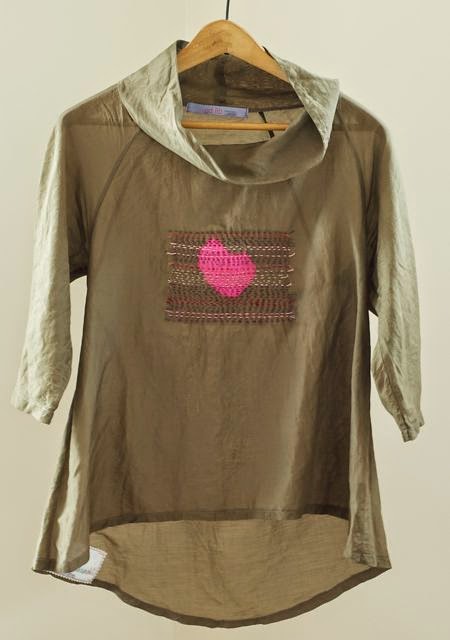
First off, I will disclose that I had no part in the design or making of this lovely, so-light-it-could-almost-float-away raglan-sleeved top. That credit is all due to a talented friend, Zoe Welch: "slow fashion" creator, writer, photographer, movie-maker - amongst other gifts - and first-rate source of encouragement, whom I met through OSF.
It doesn't belong to me, either, though it's adorable and I think I could totally rock it. It is owned by another friend and fellow OSF board member, Kat Siddle, who bought it from Zoe one night when we were picking up a donation of fabric from her home.
So why are you looking at pictures of it, you're wondering? Enter Kat's teal winter coat. It's a really cute coat, with a really badly-behaved zipper. One evening Kat's beautiful Zoe top became so completely stuck in the zipper of her coat, that after a 2-hour struggle, she had to have her fiance finally cut her out of it. Aw man. Was it ruined forever? Hmm. That might require a little side-ways thinking. That's where I came in.
I love a good side-ways think, especially when it involves giving purpose to useless, potentially ruined stuff. The hole itself was nicely placed, and nicely shaped - kind of heart-like, I thought. I happened to have, sitting on my sewing table, the left-overs from a recently finished piece - scraps from a twice-abandoned cashmere sweater, pink and deliciously soft, which I had originally lifted from Zoe's Sally Ann donations bag. What's not to love about cashmere? Or pink. It seemed a fitting material for a heart-shaped patch.
The running stitches were done with yarns from those hopeful little packets that hang on better-quality new clothes and may contain one or more of the following: a spare button that will almost certainly never know a buttonhole, a neatly-coiled length of yarn with even less hope of ever darning a hole, a symbolic sprinkling of loose beads or sequins. In rare cases - and a sure sign of the purchaser's elevated taste level - one might find two metal or plastic collar stays: remedy for the even less likely event of that uncommon, though annoying, affliction: Unequal Collar Point Orientation.
I've been saving the packets since I can remember, and most "estate" donations at OSF contain an assortment of them. I expect most of us hang on to them out of obligation, at least until their original garment has passed from our lives, when we are finally released from the responsibility of keeping them around. But by then, they've found a semi-permanent - though never entirely satisfactory - home in the junk drawer, or, more likely, the button box, mixed in with a thimble or two, a couple of dome fasteners, a corroded penny, and a few random nuts or screws, quietly living out their tasteful, but pointless existence. It was very, very satisfying to put some of them to use.
I usually bring along with me a bag of hand sewing (or un-sewing, more often than not!) whenever I have to ride the bus, wait for the doctor, sit through the kids' extra-curricular activities, or spend more than 20 minutes in a passenger seat. Two neuroplasticity sessions later, and voila! Survey says, definitely not ruined!
Considering the higher quality of garments that generally merit spare parts hang tags, I suspect the yarns used for the stitching are likely mostly real wool. I'm hoping the patch might felt up a little with washing, in a jaunty smocking-esque sort of way. We shall see.